Home / Field Notes / Festival Shirt Blanks: Bella+Canvas vs. Gildan
Field notes
Festival Merch Pricing and Revenue Share, Explained
Sponsor-funded, festival-funded or retail — how each festival merch model actually pays out, and the clauses that decide it.
Live printing at a festival is a production line, a marketing asset and a revenue line all at once, and the trouble starts when nobody says which one it is supposed to be. Festival merch pricing and revenue share models are usually settled in a hurried email between a promoter, a sponsor and a merch vendor about ten days out, which is precisely how one party ends up funding somebody else’s activation.
Here is how the money actually structures, what each model costs you, and how to tell which one your event should be using.
Sponsor-funded, festival-funded, or retail
In a sponsor-funded setup, a brand pays for the station and the blanks, and shirts go out free with their mark on them. The sponsor is buying a queue of people wearing their logo out of the gate, so their success metric is impressions and dwell time, not units. These are the easiest deals to run because nobody is arguing about margin at 9pm.
Festival-funded means the promoter pays for it as an amenity, the same way they pay for shade structures and water stations. Free to the guest, cost centre on the P&L, justified by satisfaction scores and social content.
Retail means the guest pays at the point of print. That is the only model where revenue share becomes a real conversation, because now there is revenue to split — typically between the festival, the merch rights holder, and the printing vendor.
Plenty of events blend these. A sponsor covers the station fee, the guest pays for the blank, and the festival takes a percentage of the blank sales. Blends work fine as long as everyone signed the same document.
What you are paying for before a single shirt sells
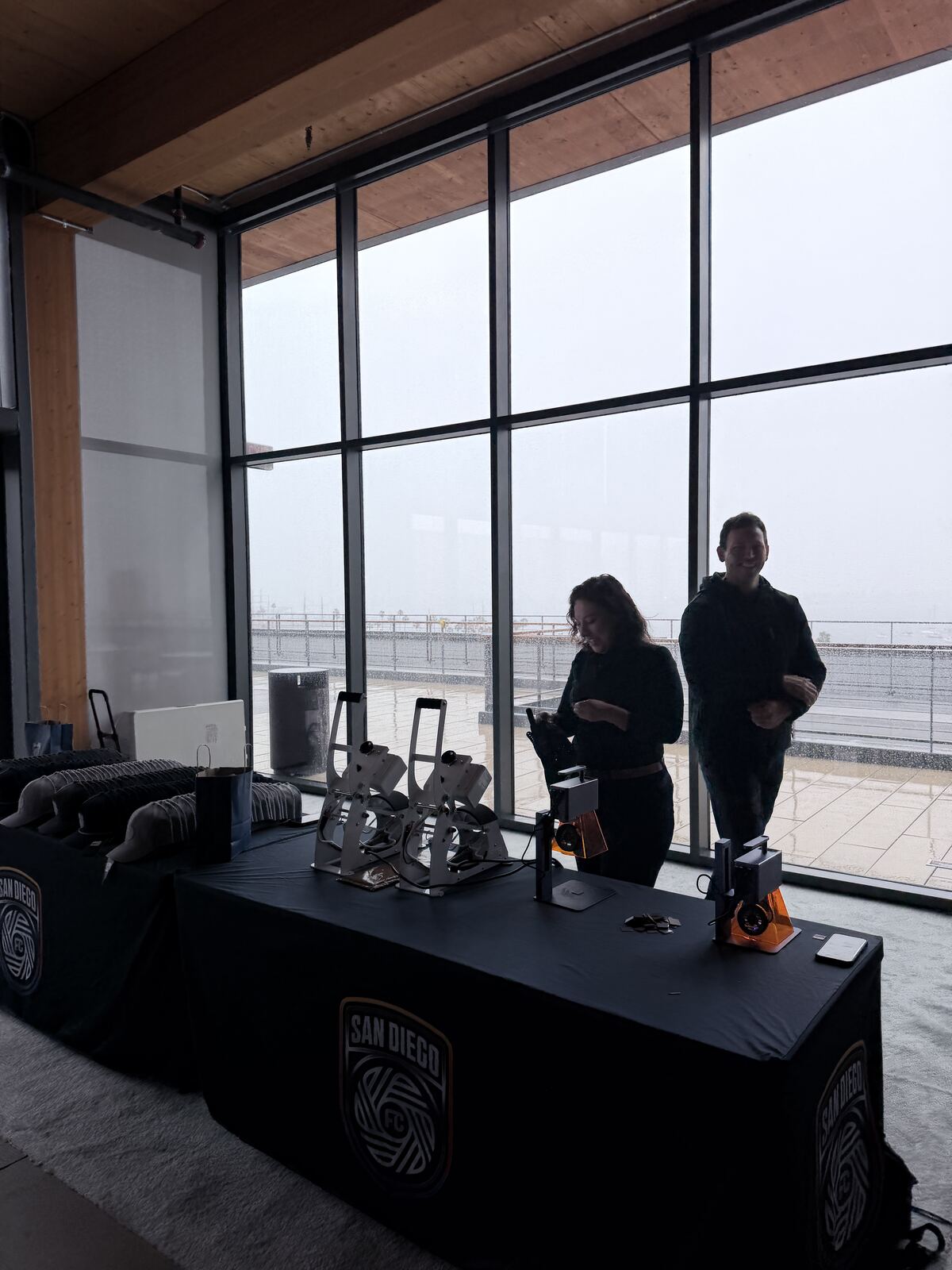
Whatever model you pick, the cost floor is roughly the same. A staffed local package starts around $5,000 and buys you the crew, the equipment, the setup and the run time. Travel outside the Orange County, LA, San Diego and Las Vegas footprint adds a flat fee on top. Blanks are separate and scale directly with volume. Power, tenting and any venue-side electrical are usually the festival’s to provide.
The key thing about that floor is that it is mostly fixed. Crew and equipment cost the same whether you print 150 shirts or 400. That single fact drives every pricing decision below it.
Run the throughput math before you agree to a split
A DTF or heat-press station finishes 60 to 90 pieces per hour when it is staffed properly and the queue is managed. Screen printing is faster still at volume on one or two colour art, but wants setup time per colour. Embroidery is a different animal — 6 to 12 minutes per piece, which makes it a premium moment, not a revenue engine.
So a single press across a six-hour gate window realistically lands somewhere between 350 and 500 finished pieces, and the low end is what you should plan against, because real festivals have weather delays, artist changeovers and a twenty-minute stretch where nobody is anywhere near your tent.
Now the arithmetic gets simple. Divide your fixed cost by your realistic unit count to get a per-piece cost floor, add the blank, and you know what a revenue share has to clear before anyone makes anything. If a proposed split does not cover that on conservative volume, it is not a partnership — it is you underwriting the event. Our notes on what drives live printing cost break the inputs down further, and keeping the print line moving covers the throughput side.
The five clauses that decide who wins
Revenue share deals fail on definitions, not on percentages. Nail these down in writing:
- Gross or net. A share of gross and a share of net can differ enormously on the same event. Say which, and define net explicitly.
- Who buys the blanks. If the vendor funds inventory, that cost normally comes off the top before the split. If the festival funds it, the split can start higher.
- Comps and sponsor pulls. Artists, guests, staff and sponsors will take shirts. Cap the comp count in the agreement or it grows all weekend.
- Leftover stock. Unprinted blanks have resale value; printed ones mostly do not. Decide in advance who owns the surplus and who eats it.
- Settlement. Name a date and a reporting format. Verbal settlement on Sunday night at load-out is not a process.
Add one more: a weather clause. Outdoor festivals lose hours. Decide now whether a washed-out afternoon reduces the fee, shifts the date, or does neither.
When each model is the wrong choice
Sponsor-funded is wrong when the sponsor’s brand overwhelms the design. Guests can spot a walking billboard and will decline one. The fix is design hierarchy — festival identity large, sponsor mark small and clean. A sponsor who insists on the reverse is buying shirts that never leave the box.
Retail is wrong at events where the crowd already paid a lot to get in and expects the on-site experience to be included. It is also wrong wherever payment friction would break the queue, because a card reader in the middle of a print line costs you more throughput than any pricing gain returns.
Revenue share is wrong when attendance is well known. Uncertainty has a price, and a vendor taking volume risk prices that in. With three years of reliable gate data, a flat fee will usually beat a share on comparable volume. Share the upside when the upside is genuinely unknown — not out of habit.
Frequently asked questions
Who normally pays for live printing at a festival?
Three parties, in descending order of frequency: a sponsor buying the activation as branded exposure, the festival itself funding it as an amenity, or the merch operation funding it as a retail line. Sponsor-funded is the most common because the sponsor is buying attention, not shirts, and the line itself is the deliverable.
Is a revenue share better than a flat fee?
It is better when attendance is genuinely uncertain and worse when it is not. A share moves risk off your budget and onto the vendor, and vendors price that risk in. If you have three years of gate data and a reliable draw, a flat fee will almost always cost you less than a share on the same volume.
What should a revenue share agreement spell out?
Whether the split is on gross or net, who buys the blanks and whether that cost comes off the top, how comps and sponsor pulls are counted, what happens to unprinted stock, and when settlement happens. Ambiguity on any one of those is where festival merch deals go wrong.
Model your event before you sign
Tell us your gate window, expected attendance and who is funding the station, and we will map the throughput and the cost floor so you can evaluate any split on real numbers. See the pricing page or request a free quote. Phone (562) 614-4800.
Pull This Station Into Your Festival
Tell us the dates and the crowd size and we will map it to a press plan.
Get a festival quote (562) 614-4800